Unit
By seven in the morning, the
By seven in the morning, the desk is already a battlefield. Sketches curl at the edges where the tea cooled overnight. A half-empty mug of cold coffee sits beside a stack of unpaid bills. The receipts from last week’s art supply order are still folded into triangles, their sharp points digging into the wood grain. The pencil sharpener’s metal shavings have scattered across the surface like confetti from a forgotten celebration. It’s the kind of clutter that doesn’t announce itself with noise, but with a low, insistent hum—something just slightly out of place, just slightly too much. The kind of mess that doesn’t need to be cleaned so much as it needs to be *reclaimed*.
Then there’s the pencil pot.
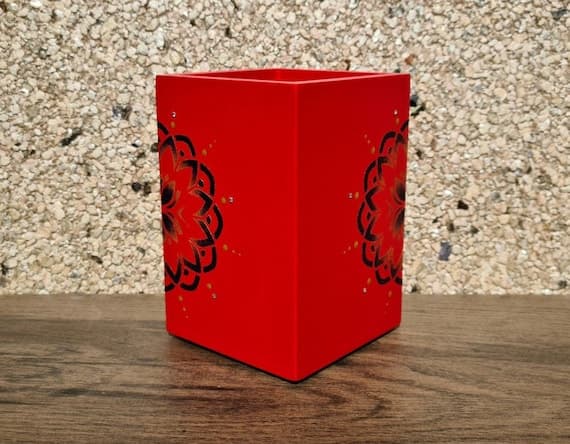
It stands upright in the middle of the desk like a sentinel that refused to surrender. The raspberry pink poplar wood is warm to the touch, its surface smooth where the lacquer has settled into the grain. The layered mandalas painted in navy and gold swirl across the sides, each circle meticulously rendered, the gold dots catching the light like tiny stars. Twelve Swarovski crystals are embedded along the rim, their facets catching the morning light and scattering it in fractured rainbows across the sketches and receipts. It’s not just a container. It’s a visual anchor, a deliberate interruption in the chaos. When your fingers brush against it, the weight is surprising—not heavy, but substantial, like holding a small, carefully tended thought.
You don’t notice it at first. Not because it’s subtle, but because it’s so *present*. It doesn’t blend in. It doesn’t apologize. It just sits there, insisting that this desk—this space—can hold more than scattered detritus. It can hold intention.
The first time you moved it here, you did so without thinking. A pencil rolled inside, knocking against the wood. The sound was soft, almost musical, like a single note plucked from a string. You paused. For the first time in days, your hand didn’t immediately reach for the next thing demanding attention. You just stood there, listening to the pencil roll, feeling the cool weight of the pot in your palm. It was a small thing. A quiet thing. But it was enough to make you stop.
That’s the thing about handmade objects
That’s the thing about handmade objects. They carry the residue of care. Not in some abstract, poetic sense, but in the way the lacquer on this pencil pot has settled into the wood, in the way the mandalas curve slightly where the artist’s brush hesitated. In the way the Swarovski crystals catch the light not because they’re polished to a mirror sheen, but because they’re placed with the kind of precision that only comes from repetition and patience. This isn’t an object that was made to be admired from a distance. It was made to be held, to be used, to be part of the daily rhythm of creation.
You reach for a pencil now, and the pot tilts slightly under your fingers. The wood creaks, a sound so faint it’s almost imperceptible, but it’s there—a reminder that this object is alive in a way that mass-produced plastic never could be. The pencil slides out, leaving a faint trail of graphite on the inside rim. You don’t wipe it away. It’s part of the story now.
By midday, the desk is still a mess. But the pencil pot sits in the middle of it all, a small rebellion against the idea that creativity requires sterility. It doesn’t demand order. It just offers a place to put the tools of creation so that the chaos can exist *around* it, rather than swallowing it whole.
That’s the first object. The second arrives later, when the light has softened and the air smells of wood lacquer and beeswax from the pencil pot’s finish.
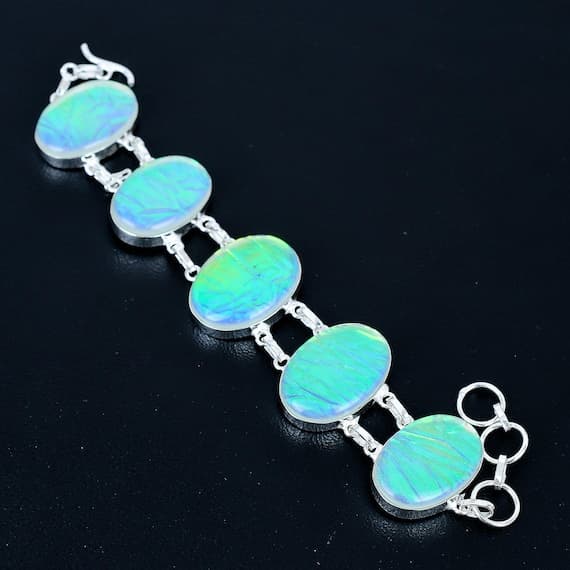
It’s the handmade Ethiopian opal bracelet, resting on the windowsill where the afternoon sun catches the edges of the opal’s shifting colors. The stones are oval, their iridescent blues and greens flickering like flames behind glass. The links are hand-forged sterling silver, each one slightly uneven, the kind of imperfection that only comes from a maker’s hands shaping metal over an anvil. You pick it up, and the weight is surprising again—not in the way of something heavy, but in the way of something that has been shaped by time. The opal’s play of color shifts as you tilt your wrist, the hues deepening and lightening like a mood you can’t quite name.
You slip it on
You slip it on. The adjustable links mean it fits loosely, the kind of looseness that allows for the slight swelling of fingers after a long day of sketching or typing. The opal rests against your pulse, cool at first, then warming to your skin. It’s not jewelry in the way we usually think of it—not something to be admired in a case or worn only for special occasions. It’s a wearable talisman, a reminder that creation is not about permanence. It’s about the moment. The opal’s shifting colors are a metaphor for the creative process itself: unpredictable, fleeting, alive with possibility.
You move your wrist, and the bracelet catches the light. The opal’s fire dances across the desk, a fleeting pattern that disappears as quickly as it appears. It’s the kind of thing that makes you pause, that makes you remember that not everything worth holding onto needs to be fixed in place.
The pencil pot organizes the chaos of creation. The bracelet centers the spirit of it.
Together, they’re not just objects. They’re participants in the ritual of making. The pencil pot holds the tools, but it also holds the intention—the quiet promise that this space is for creation, not just clutter. The bracelet reminds you that the process is as important as the product, that the unevenness of hand-forged metal and the shifting hues of an opal are not flaws, but evidence of a human hand shaping something real.
You look down at the desk. The sketches are still there. The receipts are still there. The pencil shavings are still there. But now, the pencil pot stands sentinel in the middle of it all, and the bracelet glints on your wrist, a small rebellion against the idea that a creative space must be pristine to be sacred. It doesn’t need to be perfect. It just needs to be *yours*.
And that’s the quiet power of
And that’s the quiet power of handmade objects. They don’t just fill a space. They transform it. Not by erasing the chaos, but by giving it a place to land, a place to be held, a place to be remembered.
The pencil pot doesn’t care if the desk is messy. It just cares that you have a pencil to put in it.
The bracelet doesn’t care if the sketches are half-finished. It just cares that you’re still making them.
That’s the kind of sanctuary that doesn’t require a grand gesture. Just a small, intentional choice. A wooden pot with layered mandalas. A hand-forged bracelet with an opal that shifts with the light. Two objects, each carrying the residue of care, each quietly reclaiming a space from chaos.
And that’s enough
And that’s enough.
A closer look
Questions about the products
Why does the pencil pot’s imperfection (like the lacquer settling into the wood or the slightly uneven mandalas) matter to the story’s argument about creative sanctuaries?
The article frames these imperfections as evidence of human presence and care, which transforms the pencil pot from a mere storage vessel into a visual meditation on patience and intentionality. The unevenness isn’t a flaw but a reminder that creation is a process, not a product—something the article argues is essential for reclaiming a space from chaos.
How does the Ethiopian opal bracelet’s shifting colors serve the narrative beyond being a decorative accessory?
The bracelet’s iridescent hues act as a metaphor for the creative process itself—unpredictable, fleeting, and alive with possibility. Its shifting colors mirror the moods and uncertainties of making, reinforcing the article’s central idea that impermanence and imperfection are not obstacles but integral parts of a creative sanctuary.